

It’s time the Treasury looked seriously at making gilt interest tax-free for UK savers.
With a new Prime Minister, Andy Burnham, and a new Chancellor, John Healey, preparing their first Autumn Budget on 28 October 2026, normal pre-Budget speculation is widespread, from lowering the threshold at which the so-called Mansion Tax will apply, to equalising capital gains and income taxes[1]. We think there’s a simpler, more targeted idea worth putting on the table: make the interest (coupon) income from UK government bonds (gilts) tax-free for UK-resident individual investors, when held outside an ISA or SIPP.
As we set out in two earlier pieces, Debt and taxes: the long squeeze and Bond Yields vs Stock Markets: Which One is Wrong?, the UK’s borrowing costs and debt-servicing bill are on a rising path that shows no sign of turning. This is one of the few ideas we’ve come across that could plausibly reduce that bill, at low cost to the Exchequer.
Tax-free gilt income: the cost vs the potential saving
The cost. The immediate hit to HMRC looks small: around £175m a year, on tax currently collected from existing unwrapped retail gilt holdings. Even a generous scenario, where savers respond enthusiastically, lands the Base Case cost near £2bn a year, below the hard ceiling of £8.2bn, the total Income Tax HMRC collects each year on all individuals’ savings interest[2].
The benefit. The likely benefit from yield compression starts paying out fast: potentially worth up to £2.5bn a year on this year’s issuance alone, rising to £27bn a year once all outstanding gilt stock has been refinanced at the lower rate. That’s over ten times the Base Case cost.
That’s the trade-off: a cost that tops out in the low single-digit billions, set against a saving that could run much higher and keep growing as more debt refinances. Full workings for both sides are in the Appendix; the rest of this piece makes the case for why the mechanism should work.
Are UK gilts already tax-free?
There’s some confusion worth clearing up first. Under current UK tax rules:
- Capital gains on gilts are already exempt from Capital Gains Tax for individual investors, whether the gilt is sold before maturity or held to redemption.
- Coupon (interest) income from gilts is taxable as savings income, in the same way as bank or building society interest, unless the gilt is held inside an ISA or a SIPP, where all income and gains are already tax-free.
The real gap isn’t gilts in general, it’s the coupon income on gilts held outside a tax wrapper, typically by people who have already used up their ISA allowance or their Personal Savings Allowance. That’s the specific, narrow change we’re proposing: not a new concept, but an extension of a treatment savers already get inside a wrapper.
UK savers’ £283bn dormant cash pile
The case for making this change now is strengthened by a very specific, well-evidenced problem: the vast sums of UK household cash sitting in accounts that pay little or no return. Bank of England data shows more than £283bn[3] has sat in UK bank and building society accounts paying near-zero interest for years, even as savings rates rose elsewhere. Inertia, not lack of choice, is the driver in our view.
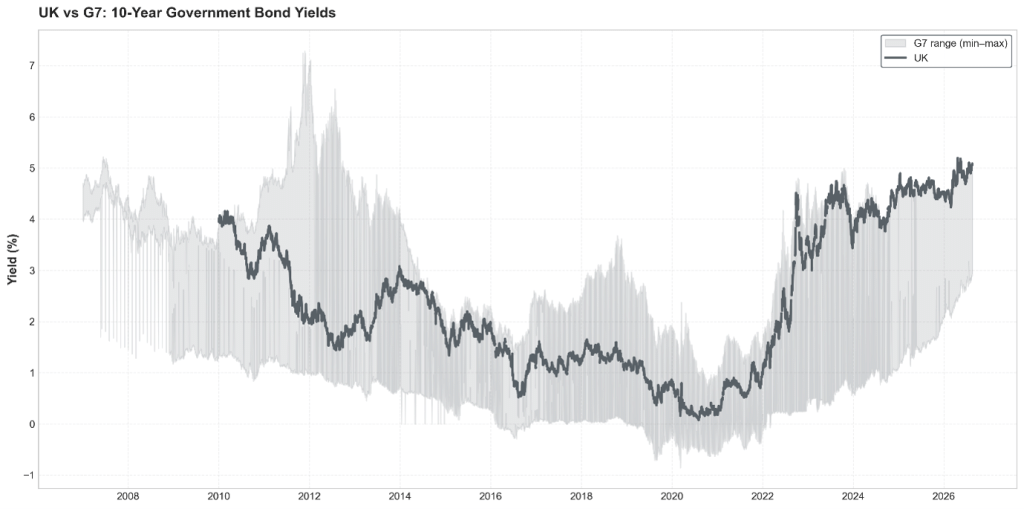
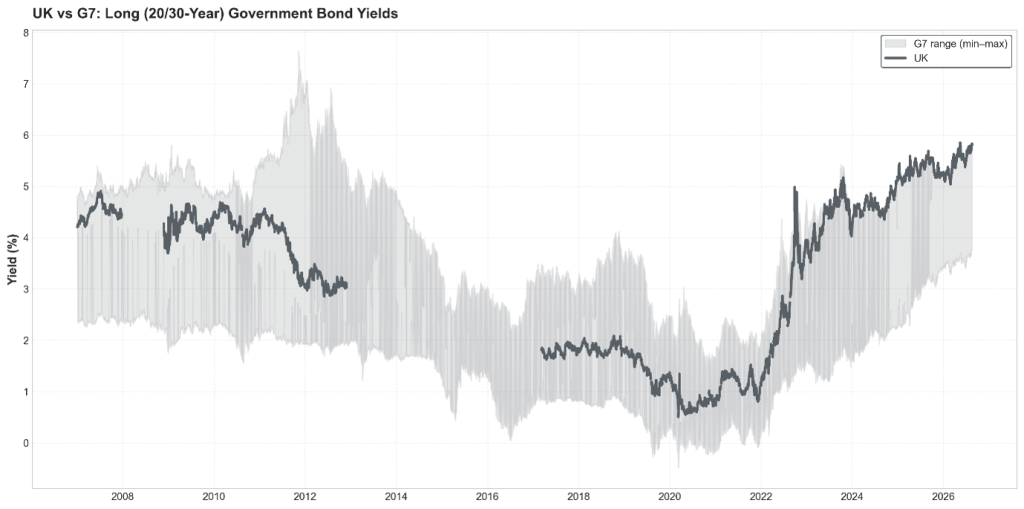
At the same time, gilt yields are elevated by historical standards, and markets are pricing UK government debt as relatively riskier than its major peers, a distinctly post-COVID phenomenon (see Chart 1, for 10 year yields[4]) rather than a historical constant. High absolute yields on what should be a risk-free domestic asset, alongside a mountain of underused household cash is precisely the kind of gap tax policy exists to bridge.
[1] Grant Thornton UK, “Autumn Budget 2026 predictions,” 16 September 2026, citing “calls from those within the Labour party to align the rates of capital gains tax and income tax”, including Lord Neil Kinnock’s July 2026 call for CGT/income tax equalisation.
[2] HMRC, “Income Tax liabilities statistics: tax year 2023 to 2024 to tax year 2026 to 2027”, Table 2.6, published 15 July 2026 (Survey of Personal Incomes basis, 2026-27 projection).
[3] https://www.bankofengland.co.uk/boeapps/database/default.asp. Series LPMZOD3.
[4] A similar pattern is evident across tenors, from 2 year to 30-year maturities. Full details in the appendix.
Chart 1: UK vs G7, 10-Year government yields, G7 min–max range shaded (2007–present)
Retail investors have started to notice: AJ Bell[1] reported gilt transactions on its DIY platform in the first months of 2026 had already exceeded the whole of 2024. But direct retail ownership of gilts remains tiny in absolute terms. Bank of England analysis[2] puts it at under 4% of all gilts in issue, and heavily skewed toward low-coupon, short-dated bonds, because savers are actively choosing a larger tax-free capital gain over higher income that would be taxed. Eliminating the tax on coupon income would remove that distortion, letting investors choose gilts on their own merits rather than gaming the tax system.
What would tax-free gilt income cost the Treasury?
We’ve built our own estimate, using public DMO, Bank of England and HMRC data. Nobody else appears to have costed this: not HMRC, not the OBR, not a single think tank. The headline: the immediate cost looks small, just £175m a year; the medium-term cost, once savers actually respond to the incentive, could plausibly reach £2bn a year, against a hard ceiling of £8.2bn. Full workings, assumptions and sensitivity tables are in the Appendix (Tables 1 & 2).
How much could tax-free gilts save on UK borrowing costs?
This is the side of the ledger that’s too easily skipped over, and where the real case for the policy lives. At the time of writing, 10-year gilts were yielding 5.2%[3], against 4.2% for the 10-year Greek government bond, a country hardly renowned for fiscal discipline. In other words, a gap of roughly 100bps. The UK also trades wide of other southern European peers too, including Portugal, Italy and Spain (the so-called ‘PIGS’).
The DMO’s financing remit for 2026-27 puts gross gilt sales at £246bn for the year, somewhere in the region of £500bn-£750bn over a typical two-to-three-year run, once refinancing is included. If £200bn of that demand came from UK savers newly drawn in by a tax break, that’s not a rounding error: it’s 30-40% of the government’s entire financing need, from a buyer that barely shows up in the market today.
The closest empirical precedent for what that might be worth is the Bank of England’s own quantitative easing research: the first £200bn of QE1 gilt purchases was associated with roughly 100bps of yield compression. Applying that same rule of thumb to a comparable retail inflow points to a similar order of magnitude, enough, in principle, to bring UK borrowing costs into line with Greece. Three caveats apply, set out in full in the Appendix (Table 3): the Bank’s own estimate has been disputed, and QE was a price-insensitive buyer in a way retail money chasing a tax break may not be, and the UK’s ongoing deficit means new supply keeps coming regardless of retail demand. Even so, applied to the full gilt stock over time, the saving could compound into the tens of billions a year, with full sensitivity in Table 4.
Mansion tax vs tax-free gilt income: a Budget contrast
It’s worth noting what else is reportedly on the table. It has been reported[4] that the Treasury is actively weighing cutting the ‘mansion tax’ (formally, the High Value Council Tax Surcharge) threshold from £2m to £1.5m, potentially drawing in up to c.150,000-160,000 further homes on top of the c.134,000 already in scope, the overwhelming majority of them in London and the South East. It’s the kind of measure that raises real money but does so by taxing a narrow, geographically concentrated base, effectively London and the South subsidising the rest of the country, and it’s already proving divisive before any decision has been made.
We’re not taking a view on that policy here. But it’s a useful contrast: a mansion tax raises revenue by taking more from a specific group of homeowners. What we’re proposing takes a different approach: it doesn’t raise money the way a tax increase does, it aims to lower the government’s own borrowing costs instead. Both are candidates for the same Budget. Only one of them could plausibly pay for itself many times over.
Risks and open questions
To be fair to the other side of the argument: this would add a new source of complexity to an already complicated tax system and our estimates could prove inaccurate. None of that is a reason to dismiss the idea; it’s a reason for it to be modelled properly, rather than ignored.
Our view at Morenti Wealth Partners
Fiscal headroom is desperately scarce. Most of the levers available to the Chancellor involve raising taxes on someone. It’s one of the only levers on the table that could cut the government’s own borrowing costs while giving savers a real, low-risk reason to move dormant cash. It deserves a proper look ahead of 28 October.
What do you think: genuine incentive worth trying, or added complexity the tax system doesn’t need? We’d be interested in your view.
[1] https://www.ajbell.co.uk/group/news/retail-investors-take-advantage-bond-market-gyrations-snapping-gilts
[2] https://bankunderground.co.uk/2026/01/15/retail-investors-participation-in-the-gilt-market/
[3] Data taken at 22/9/26 from www.tradingeconomics.com
[4] Reported by The Times and summarised by S&W Group, September 2026: the Treasury is said to be weighing a cut in the High Value Council Tax Surcharge threshold from £2m to £1.5m, which independent analysis by Tax Policy Associates estimates would draw in a further c.150,000-160,000 properties, on top of the c.134,000 already in scope at the £2m threshold, with roughly 85% of affected properties in London and the South East.
Appendix
Appendix A sets out the assumptions, methodology and sensitivity ranges employed.
A1. Gilt coupon tax exemption: the static cost estimate
Total gilts in issue currently stand around £2.7 trillion (DMO Quarterly Review). Direct UK household ownership is the smallest slice: ONS data, which only captures gilts registered directly in someone’s own name, puts it at a token £3bn; the Bank of England’s own transaction-level analysis, which also captures retail holdings via investment platforms, puts it at up to £100bn.
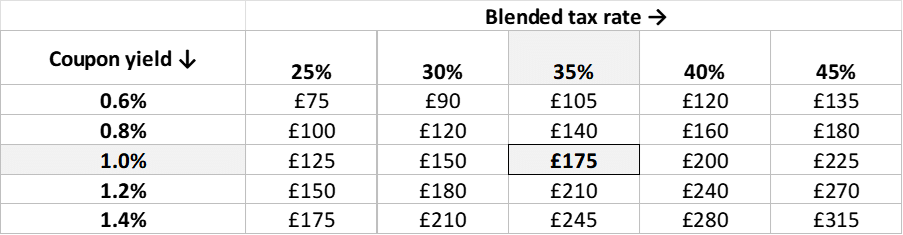
For this analysis, we’ve assumed half of this holding sits outside tax wrappers. Because retail holdings are concentrated in low-coupon gilts, the actual taxable income this pool generates today is modest. A 1% yield, taxed at a blended rate of 35%[1], implies £175m in tax flowing to HMRC. Table 1 shows the sensitivity to these assumptions.
[1] HMRC, Table 2.6 (see note 1): the 2026-27 total Income Tax liability on savings income (£1,650m basic-rate + £2,560m higher-rate + £3,970m additional-rate = £8,180m) implies an average effective rate of ~35% on taxable savings income.
Table 1: Sensitivity Analysis – Estimated Tax Cost of Exempting Gilt Coupon Income (£m)
A2. Gilt coupon tax exemption: the dynamic cost estimate
The bigger, harder-to-pin-down number comes from what happens next. Once the tax is removed, two things plausibly follow: existing holders stop deliberately chasing low coupons, and cash savings, both zero-interest and higher-interest, start moving into now tax-free gilts.
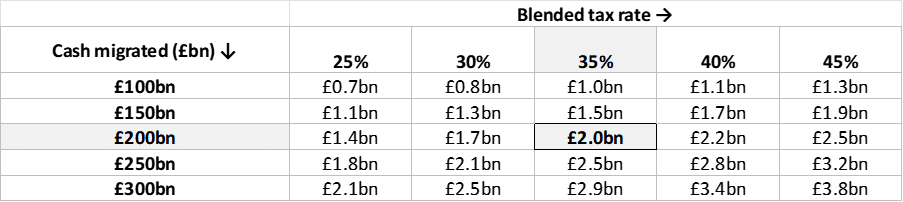
The ceiling here is arguably the full £8.2bn HMRC collects each year in tax on individuals’ savings interest, because any saver holding taxable interest income, not just cash earning nothing, could gain from switching. Our Base Case is £2bn a year, using a forgone interest rate of 2.8% (the midpoint between AJ Bell’s easy-access average of 1.6% and typical fixed-term/notice rates of c.4%) at the 35% blended tax rate derived in Table 1. Table 2 shows the full sensitivity.
Table 2: Sensitivity Analysis – HMRC Cost, Cash Migrated vs Blended Tax Rate
What keeps our Base Case estimate below the £8.2bn ceiling is the same inertia seen elsewhere in this piece: over £283bn has sat earning zero interest for years despite tax-free alternatives already existing. If that pattern holds, most savers won’t act on this incentive either, but that’s a behavioural bet, not a structural limit. These are our own numbers, built transparently and open to challenge; we’d welcome the OBR or the IFS running their own numbers.
A3. Gilt yield impact: sizing the potential saving
To our knowledge, no study has modelled gilt-market elasticity to a demand shock of this specific kind, so what follows is an anchor, not a forecast. The closest public precedent appears to be the Bank of England’s own quantitative easing research. Joyce, Lasaosa, Stevens and Tong (2011) found the first £200bn of QE1 gilt purchases, around 14% of GDP and 29% of the gilts’ free float at the time, was associated with roughly 100bps of compression in medium-to-long gilt yields, implying a rule of thumb of about half a basis point of compression per £1bn purchased.
Applying that rule of thumb to a retail inflow of £200bn points to compression of a similar order of magnitude to QE1 itself: around 100bps, enough in principle to bring UK borrowing costs into line with Greece, which already exempts individuals from tax on its own government bond interest[1]. Table 3 sets out the workings across a range of inflow assumptions.
[1] PwC, “Greece: Individual – Income Determination,” Tax Summaries: interest on Greek government bonds is exempt from income tax for individuals.
Table 3: Sizing the Yield Impact – Cumulative Retail Inflow and Implied bps Compression

Three caveats. First, the Bank’s own estimate has been disputed: the Bank for International Settlements has argued it may overstate QE’s effect. Second, QE was a price-insensitive buyer (the Bank purchased regardless of yield), whereas retail money chasing a tax break could, over time, be more price-sensitive, though we don’t believe this is the binding constraint currently, with longer-maturity gilt yields above 5% against UK inflation of 3.3% in August 2026. Third, the UK’s ongoing deficit means large gross issuance continues regardless of retail demand; a one-off stock of redirected savings could be absorbed within a year or two, after which the yield effect may fade, and to the extent retail money is drawn from other bond markets rather than pure cash, it could modestly raise private-sector borrowing costs elsewhere. Mid-to-long term, the UK government still needs to rein in the size of its ongoing budget deficit.
A4. Debt-servicing savings in pounds and billions
Using the estimates in Tables 1-3, we have estimated the size of potential savings at different points as more of the government’s debt gets refinanced at the new, lower rate. For brevity we’ve shown this in 25bps increments.
Table 4: Sensitivity Analysis – Potential Annual Debt-Servicing Saving (£bn)
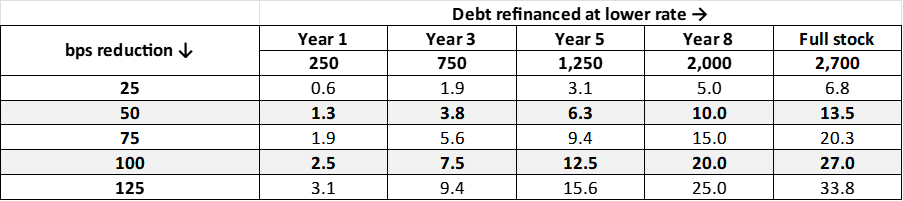
A relatively modest move applied only to this year’s issuance is worth several hundred million; the same move applied to the full stock, once the government’s portfolio has fully refinanced, is worth tens of billions. Even a 25bps improvement, sustained over time, is worth real money.
A 100bps re-rating, taking UK borrowing costs in line with Greece and squarely within the range the Bank’s own QE research and the size of the UK’s addressable cash pool would support, could transform the public finances’ interest bill entirely. This potential gain needs to be netted against the cost estimates in Tables 1 & 2.
Neither outturn is guaranteed. But the two sides of this ledger are different in kind: a capped cost against an open-ended saving. That’s worth the Treasury modelling properly, rather than dismissing out of hand.
Appendix B
Appendix B provides more context on the post COVID phenomenon of UK government borrowing costs across maturity ranges being elevated versus G7 peers.
Chart 2: UK vs G7, 2-Year government yields, G7 min–max range shaded (2007–present)
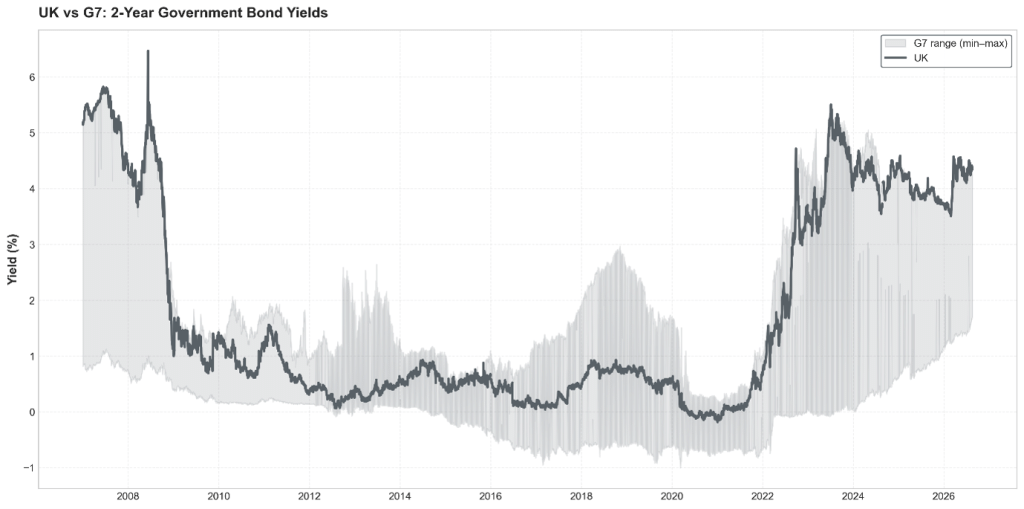
Chart 3: UK vs G7, 5-Year government yields, G7 min–max range shaded (2007–present)
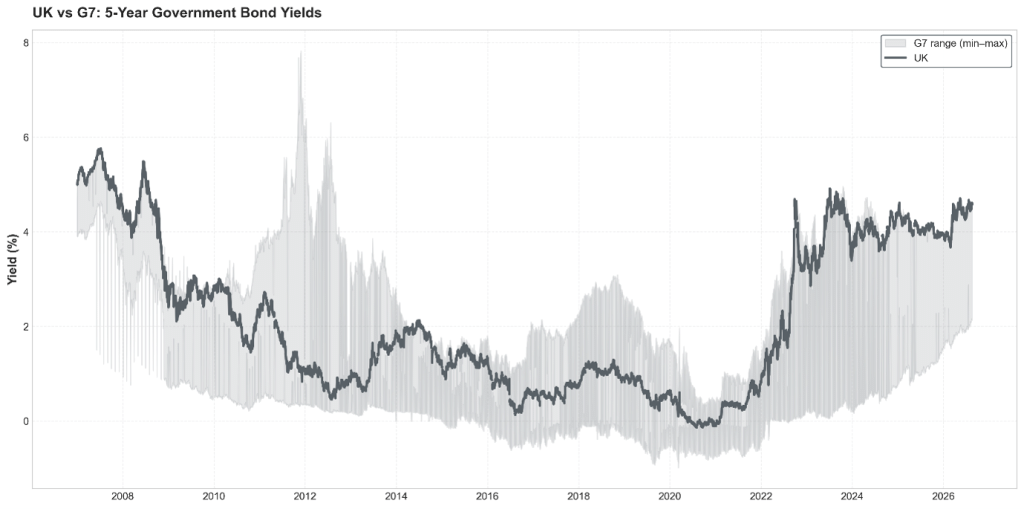
Chart 4: UK vs G7, 20/30-Year government yields, G7 min–max range shaded (2007–present)
Disclaimer
This article is for information only and does not constitute personal financial or tax advice. Tax treatment depends on individual circumstances and may change. The cost estimate above is an independent, illustrative calculation based on public Debt Management Office, Bank of England and HMRC data, using stated assumptions, it is not an official government or third-party costing, and should be treated as directional rather than precise. The potential debt-servicing saving discussed above is similarly illustrative and not a forecast. You should seek personalised advice before making financial decisions.
About Morenti Wealth Partners
Morenti Wealth Partners is a trading style of Burgess & Lee Ltd, an independent financial advice firm specialising in retirement and inheritance tax planning. Morenti Wealth focuses on delivering clear, actionable strategies tailored to clients’ unique goals, stripping away unnecessary complexity and costs. Burgess & Lee is authorised and regulated by the Financial Conduct Authority (FCA).